Will We Judge Angels? Reading 1 Corinthians 6:3 in Context
Yes—Paul says that believers will judge angels in 1 Corinthians 6:3. He says it while correcting the way Christians were handling disputes. The passage affirms a remarkable future responsibility, but it does not explain which angels, the exact procedure, or a date. Its immediate lesson is about wisdom and conduct now, not a detailed tour of a heavenly courtroom.
It is one of those Bible sentences that makes a reader stop halfway down the page. Angels? Us? Surely there must be several more chapters explaining the job description.
There are not several more chapters here. Paul moves straight back to the troubles in Corinth. Following him back into that setting helps us hear what he is actually saying.
What does 1 Corinthians 6:3 actually say?
“Know ye not that we shall judge angels? how much more things that pertain to this life?”
1 Corinthians 6:3, King James Version
Read 1 Corinthians 6:1–8 together. The opening question concerns believers taking their grievances against one another before outside courts. In verse 2, Paul refers to the saints judging the world. In verse 3, he adds angels. He then asks why the church cannot find someone wise enough to help settle its own disagreements.
His argument moves from a greater responsibility to a smaller one: if God’s people will share in such serious future judgment, they should be able to approach ordinary disputes with wisdom. The reference to angels strengthens that point. It is not the beginning of a separate lesson that describes every part of the future event.
Verses 7 and 8 sharpen the correction. The problem includes believers wronging and defrauding one another. Paul is challenging the harm being done, not simply criticizing the location of a legal meeting.
Which angels will be judged?
This is where Christians move from the verse’s clear statement to interpretation. The verse says “angels”; it does not add “fallen,” “faithful,” or a list of names.
Some Christian explanations connect it with judgment involving fallen angels. Others understand “judge” in the broader sense of exercising authority or rule, and consider a role involving faithful angels as well. Those explanations draw on how readers connect this verse with other passages and their understanding of the future kingdom.
For example, the Berean Bible Society’s explanation emphasizes a governing role involving faithful angels. Patterns of Truth connects the question with fallen angels and future judgment. The Grace Evangelical Society’s discussion also explores the timing and meaning of the statement. These are named Christian interpretations, not extra sentences in Paul’s letter.
We can compare those views without pretending the short verse settles every difference. A useful reading habit is to ask, “Can I point to these words in the passage, or am I following an explanation built from several passages?” Both kinds of reading can be thoughtful. They should not be confused.
The text, the interpretation, and the unknowns
| Question | What the passage gives us | How to speak carefully |
|---|---|---|
| Will believers judge angels? | Paul explicitly says “we shall judge angels.” | Affirm the statement while keeping its setting in view. |
| Why does Paul mention it? | He is addressing disputes and wrongdoing among believers. | Return to wisdom, responsibility, and how people treat each other. |
| Which angels? | The verse does not identify a group. | Explain the main interpretations as interpretations. |
| Exactly how and when? | No detailed process or timetable appears in verses 1–8. | Do not present an imagined courtroom or fixed schedule as Paul’s description. |
| Will I review my personal guardian’s work? | Paul says nothing about such an arrangement here. | Leave that picture out of the claim. |
The last question is easy to imagine because guardian angels feel personal. But a familiar image is not evidence. Our guide to angels and free will explores a different question. The article on fallen angels in the Bible offers background without turning this verse into a complete angelic biography.
What does the passage ask of us today?
Paul’s correction is humbling. The people being reminded of a great future role are also being confronted about present wrongdoing. The point is not to enjoy feeling more important than angels. It is to take ordinary faithfulness seriously.
Before using this passage in a disagreement, consider three questions:
- Am I trying to resolve a wrong, or merely win?
- Have I listened honestly and sought wise, trustworthy help?
- Is my own behavior adding to the harm?
Those questions are an application of Paul’s argument. They are not a substitute for reading the passage, and they do not give a church leader unlimited authority over someone else’s safety.
This passage should never be used to pressure someone to conceal abuse, avoid reporting a crime, or give up lawful protection. A discussion about disputes among believers is not permission to shelter wrongdoing. Protecting someone who is being harmed and seeking appropriate help must not be dismissed as a lack of faith.
A Gus-shaped pause
The following is an original fictional reflection, not a scene quoted from the novel or a claim about how angels act.
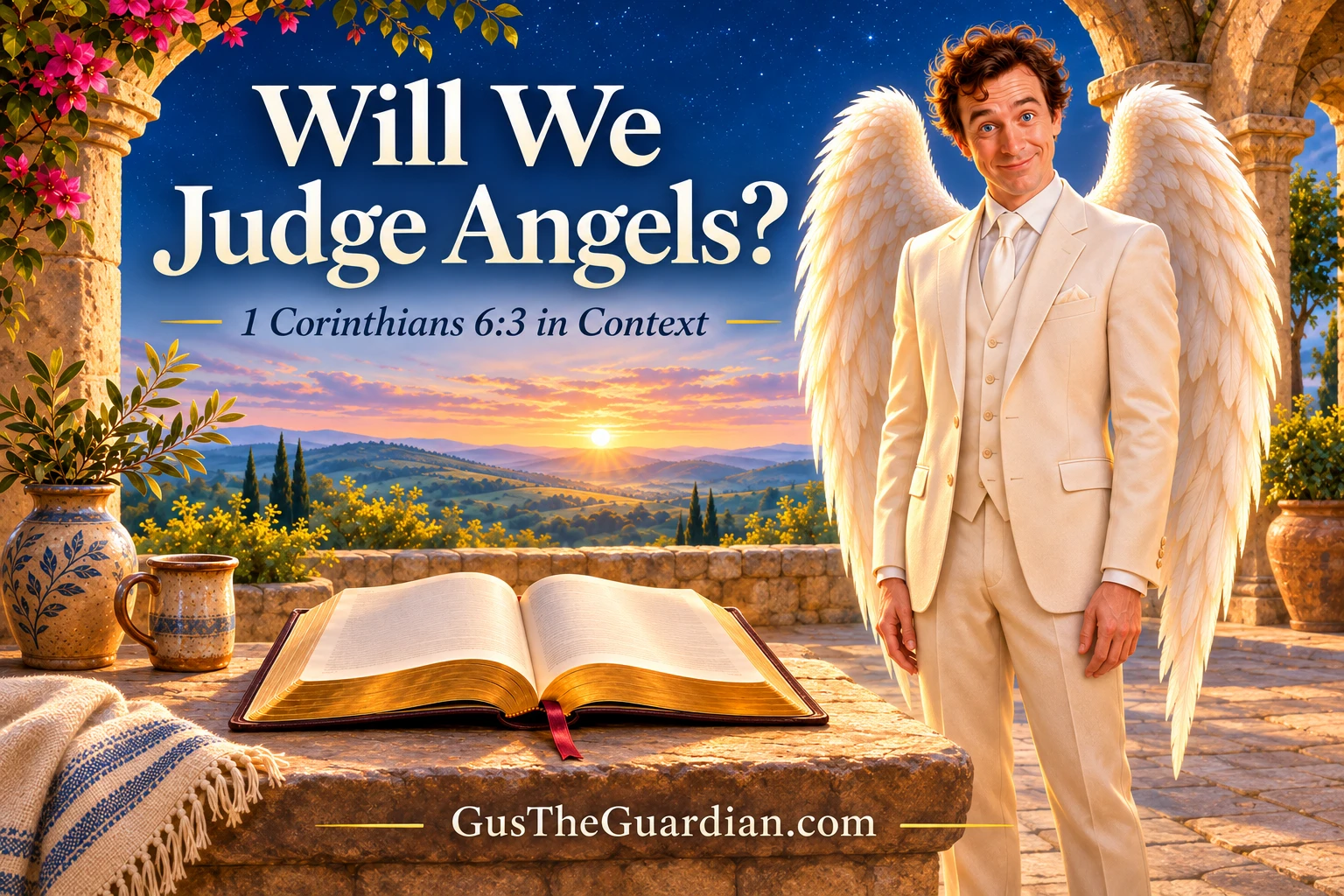
Imagine Andy hearing that believers will judge angels and immediately wanting to know whether there will be an official chair. In the world of our stories, Gus might have good reason to hope Andy first remembers where he left his shoes.
The smile brings us back to a serious point: curiosity about a future assignment should not crowd out today’s small responsibilities.
The simple lesson: Receive what Scripture says with wonder, hold unanswered details with humility, and practice wisdom in the responsibilities already in front of you.
Keep reading
For another passage about angels, explore what angels long to look into in 1 Peter 1:12. For the fictional world of Andy and Gus, Chapter 1 of the illustrated adventure is free.
Sources and reading notes
- 1 Corinthians 6, KJV — the primary passage; read verses 1–8 for the immediate argument.
- Berean Bible Society: Will We Judge Angels? — a governing interpretation.
- Patterns of Truth: When Do We Judge Angels? — another Christian explanation of judgment and timing.
- Grace Evangelical Society: When and How Will We Judge Angels? — further interpretive discussion.