Why Do Angels Say “Do Not Be Afraid”?
Angels say “Do not be afraid” in several biblical encounters to reassure frightened people and prepare them to hear God’s message. The words lead into news, explanation or a task. They do not prove that every angel has a terrifying appearance, and Scripture does not record every angelic encounter beginning with the same phrase.
It is easy to remember the dramatic entrance and overlook the reassurance. But the message matters. At Bethlehem, the shepherds are directed toward the birth of Jesus. At the tomb, the women are told about his resurrection. The angel is drawing attention to what God has done.
Read what comes after the reassurance
A useful reading habit is to continue past the familiar phrase. Ask who is afraid, what the narrator says caused the response, and what the messenger communicates next. That keeps the words inside their story.
You will find several different situations: a priest interrupted during worship, a young woman considering an extraordinary greeting, shepherds surrounded by divine glory, and women visiting a tomb. Their experiences share reassurance without becoming identical scenes.
Zechariah: a message in an unexpected moment
In Luke 1:11–20, Zechariah is serving in the temple when an angel appears near the incense altar. He is troubled and afraid. The angel reassures him, speaks about the birth of John and explains John’s coming role.
The messenger identifies himself as Gabriel. The account moves from fear into a particular announcement, not a general description of angel anatomy. It also has a difficult turn when Zechariah questions the message and becomes unable to speak. Reassurance does not make the encounter trivial; God’s message still carries significance.
This scene is part of Luke’s introduction to John and Jesus. Reading it as merely a startling supernatural visit misses the larger story the Gospel is telling.
Mary: troubled by the greeting
Later in Luke 1:26–38, Gabriel comes to Mary. Luke specifically connects her troubled response with what was said: she considers the meaning of the greeting. The reassurance leads into the announcement that she will bear Jesus.
Mary asks how this will happen, receives an answer and responds in trust. The passage gives us conversation and reflection, not a portrait of someone who is incapable of feeling unsettled. Faith includes listening and responding in the middle of an overwhelming moment.
For the named messenger’s wider biblical role, read Who Is Gabriel in the Bible, and Whom Does He Visit?
The shepherds: fear gives way to good news
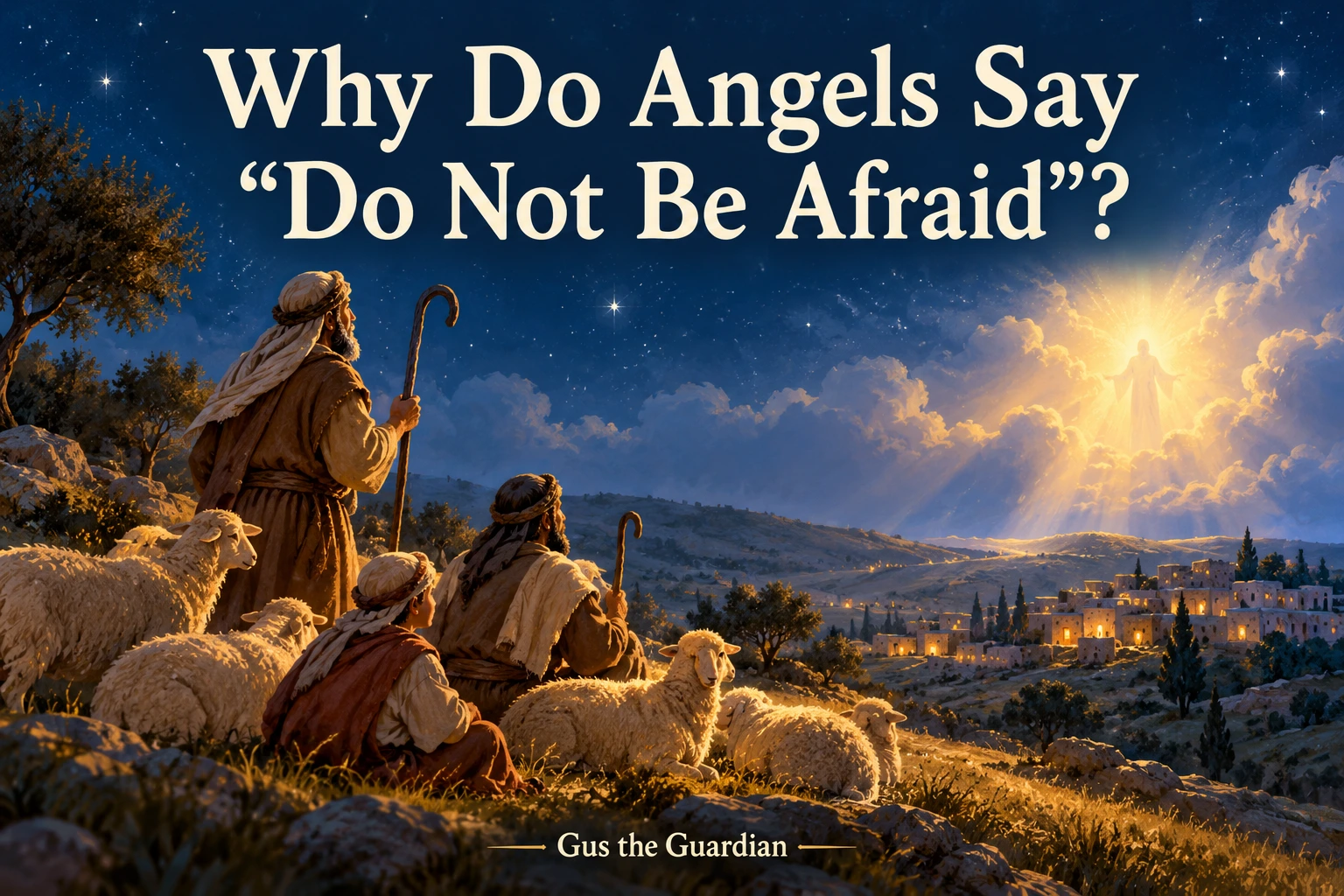
Luke 2:8–20 describes shepherds watching their flock at night. An angel appears, the Lord’s glory shines around them and they become greatly afraid. The reassurance introduces news about the Savior’s birth and a sign by which they can find the child.
The shepherds go to Bethlehem and later praise God. The story’s movement is from fear through hearing to response. Its center is Jesus, rather than the messenger as a spectacle.
That is one reason the Christmas scene can remain encouraging long after Christmas. The people receiving the announcement are in the middle of ordinary work. God’s good news reaches them there, and they are invited to respond.
At the empty tomb: fear and joy together
In Matthew 28:1–10, the setting is dramatic: an earthquake, an angel whose appearance is compared with lightning, and guards overcome by fear. The angel reassures the women seeking Jesus and announces that he has risen.
The women leave with fear and great joy. That detail matters. The narrative does not say the reassurance instantly removes every strong emotion. They respond to the good news while still affected by what has happened.
Jesus then meets them and also tells them not to fear. Keep those speakers distinct: Matthew records both an angel’s message and Jesus’ own words. The encouragement belongs within the Gospel’s witness to the resurrection.
Is it always about a frightening appearance?
Not in the same way in every account. Matthew describes an extraordinary appearance at the tomb. Luke names the glory surrounding the shepherds. With Mary, the text emphasizes the greeting and its meaning. There is no need to invent a single visual explanation for all three.
Nor should pictures of wheels, many eyes or different heavenly beings be merged into one standard angel that supposedly explains every reaction. The guide to biblically accurate angels connects those descriptions to their particular passages.
A story can be awe-inspiring because of God’s presence, an unexpected message or the importance of what is being announced. A reader who reduces it to “angels must look like monsters” misses much of what the text actually supplies.
Do angels always begin with “Do not be afraid”?
No. Scripture records varied introductions and conversations. Even within resurrection accounts, the wording differs. Luke 24:1–8 describes frightened women and two men in dazzling clothing, but their recorded address begins with a question about seeking the living among the dead.
The recurrence of a phrase is meaningful without becoming a universal script. Avoid numerical claims that it appears exactly once for every day of the year unless someone has defined and checked the translation, phrase variants and counting method. No such count is needed to appreciate the reassurance.
Joseph’s dream: courage for a specific decision
Matthew 1:18–25 gives another important context. In a dream, an angel tells Joseph not to fear taking Mary as his wife and explains the child’s conception and mission. The words concern a particular decision, not merely alarm at a visible visitor.
Joseph wakes and acts on the instruction. The scene reminds us that reassurance can lead into responsibility. Courage in these accounts is not just feeling calmer; it includes responding faithfully to what God has made known.
Dreams raise additional questions, which are treated separately in Can Guardian Angels Appear in Dreams? The biblical account identifies its messenger; it does not make every modern dream an angelic message.
What can Christians take from these words today?
First, listen for the substance of God’s message rather than chasing a dramatic experience. These passages point toward God’s saving work and people’s response to it. Reading the surrounding chapter is often more fruitful than trying to imagine the entrance.
Second, allow room for honest emotion. Mary reflects and asks a question. The women at the tomb carry both fear and joy. Feeling frightened does not by itself tell the whole story of a person’s faith.
Third, distinguish encouragement from a guarantee. These passages do not promise that Christians will never face suffering or that everyone will receive an angelic visit. They do offer a rich picture of God addressing people with purpose and care. The broader theme of refuge is explored in the Psalm 91 guide.
For a short family conversation, read Luke 2:8–20 and ask: What frightened the shepherds? What news did they hear? What did they do next? End with thanks for God’s care, without pressuring anyone to report a special experience.
Questions readers ask
Does fear mean the angel came to harm someone?
Not in the encounters discussed here. Read the actual message and outcome. The person’s alarm does not by itself establish the messenger’s purpose.
Does the phrase identify a personal guardian angel?
No. Reassurance alone does not establish a lifelong assignment. For that separate question, see the biblical foundations of guardian-angel belief.
Are “fear not” and “do not be afraid” different messages?
They are familiar English ways of rendering reassurance. Compare translations within the same passage before treating a wording difference as a separate theological teaching.
A hopeful way to keep reading
The next time you encounter these words, read the following sentence too. You may find a birth announced, a task explained or the resurrection proclaimed. The reassurance opens the way to hear something larger than the fear.
For a different kind of heavenly perspective, meet the fictional Gus in the opening of the novel. His adventures belong to storytelling; the biblical explanations above rest on the linked passages.