Who Is Michael the Archangel, and What Does the Bible Say He Does?
Michael is a heavenly prince associated with Daniel’s people, the figure Jude calls “the archangel,” and the leader of angels who fight the dragon in Revelation 12. His biblical appearances emphasize protection, resistance to evil and service under God’s authority.
Michael has a prominent place in Christian imagination, but the biblical portrait is surprisingly concise. We meet him through a few important actions rather than a continuous life story. Reading those encounters together gives us something more useful than an elaborate biography: a clear sense of what the texts actually say he does.
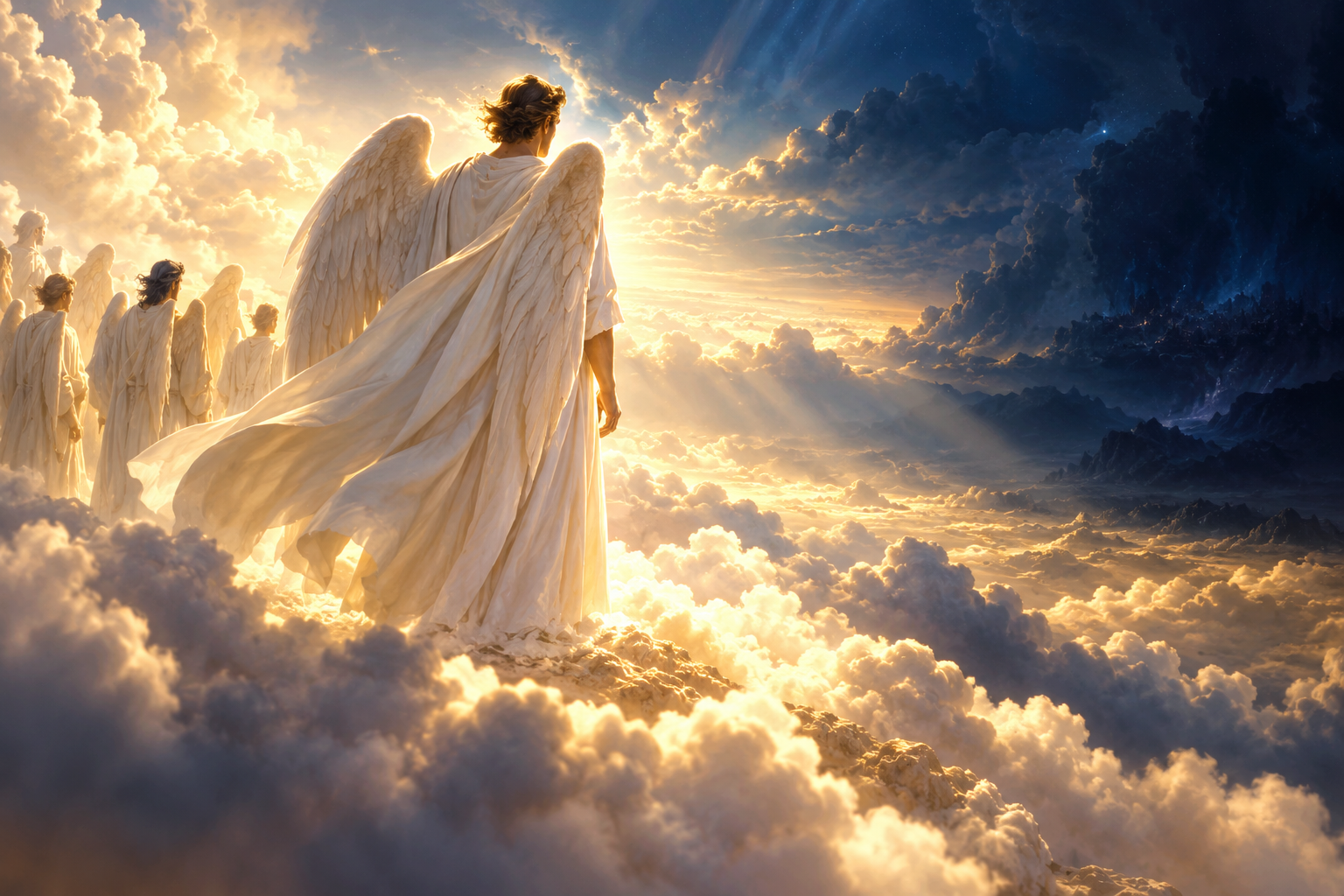
Original artistic interpretation inspired by Michael’s leadership in Revelation 12. The wings, clothing, setting and figures’ appearances are artistic choices; the passage does not provide this portrait.
Michael in Daniel: help during conflict
Daniel 10 opens with mourning, a startling vision and a message that Daniel struggles to receive. The speaker describes opposition from the prince of Persia and says Michael came to help. Verse 13 calls Michael one of the chief princes; verse 21 associates him specifically with Daniel’s people. Daniel 10:12–21, NABRE.
The scene gives the reader a glimpse of heavenly conflict surrounding earthly events. It also leaves questions unanswered. It does not tell us everything about the opposing princes, how their conflict works or what Michael looks like. The description of a shining figure earlier in the chapter should not be transferred to Michael as though it were his portrait.
A little later, Daniel 12:1 describes Michael as the great prince guarding Daniel’s people. The surrounding passage speaks of extraordinary distress, deliverance and resurrection. Michael’s role belongs to that larger horizon of God’s care and judgment. Daniel 12:1–3, NABRE.
For Christian reflection, these scenes can offer encouragement during uncertainty. Their application is not a promise that believers will avoid every hardship. They place heavenly help within a story that takes suffering seriously.
Michael in Jude: strength without reckless speech
Jude 9 introduces a different encounter: Michael disputes with the devil over Moses’s body. Jude explicitly calls him the archangel. The verse does not explain the full background of the dispute, so a careful account should stop short of supplying motives, conversations or events the letter does not give.
What Jude does emphasize is Michael’s restraint. Rather than pronouncing an abusive judgment himself, he appeals to the Lord’s rebuke. In a passage criticizing people who speak arrogantly about what they do not understand, that restraint matters. Michael’s dignity is shown through his conduct as well as his title. Jude 8–10, NABRE.
That makes this a particularly useful passage to remember when discussions of angels become combative. A reasonable Christian application is that confidence in God need not become boastful speech about spiritual powers. That is a reflection on Jude’s contrast, not an additional instruction Michael gives us.
Michael in Revelation: the dragon is defeated
Revelation 12:7–9 portrays Michael and his angels fighting the dragon and its angels. The dragon is defeated and cast down; the text identifies it as the devil and Satan. Michael appears as a leader in the heavenly conflict, not as an isolated adventurer. Revelation 12:7–9, World English Bible, Catholic edition.
The next verses widen the focus to God’s kingdom, the authority of Christ and the victory associated with the Lamb. That context helps keep an article about Michael centered on the message of Revelation rather than fascination with a powerful character. Revelation 12:10–12.
Because Revelation communicates through visions and rich imagery, an illustration cannot settle every interpretive question about the scene. Nor do these verses give a detailed account of Michael’s creation, an exact weapon inventory or a complete chronology of every heavenly conflict.
The biblical encounters at a glance
| Passage | Michael’s role | Important boundary |
|---|---|---|
| Daniel 10:13, 21 | Helps in heavenly conflict; associated with Daniel’s people. | The speaker’s identity and Michael’s identity must not be merged. |
| Daniel 12:1 | The great prince guarding Daniel’s people. | Read within the passage about distress and deliverance. |
| Jude 9 | The archangel who disputes over Moses’s body. | The full background is not narrated here. |
| Revelation 12:7–12 | Leads angels against the dragon. | The surrounding victory language points to God and Christ. |
Does archangel mean Michael is the only one?
Jude names Michael as the archangel. First Thessalonians 4:16 also refers to an archangel’s call at the Lord’s coming, but it does not give that archangel’s name. Identifying the voice as Michael is an interpretation. These verses do not supply a universal list of seven named archangels. 1 Thessalonians 4:16, NRSVUE.
Christian traditions develop the language further. Catholic worship honors Michael, Gabriel and Raphael together on September 29; Orthodox commemoration includes Michael and other named heavenly powers. Those traditions should be identified as traditions rather than presented as a single list printed in all Christian Bibles. Vatican Directory on Popular Piety, 215; Orthodox Church in America, Synaxis of Michael and the Other Bodiless Powers.
For the distinction between a title and a guarding mission, see Are Guardian Angels the Same as Archangels?.
Do Christians interpret Michael’s identity the same way?
No. Orthodox teaching presents Michael among the angelic heavenly powers. A different reading is represented by the Seventh-day Adventist Biblical Research Institute, which argues for identifying Michael with Christ while acknowledging that the biblical passages do not explicitly make that identification. Naming those approaches is more accurate than suggesting that every Christian reads the figure identically. OCA account; Biblical Research Institute: Is Michael another name for Jesus?.
The encounter summaries above keep to the names, titles and actions stated in the passages. They do not require us to fill the gaps with an imagined early life, secret assignment or detailed appearance.
What should we remember about Michael?
Remember the pattern: Michael helps, guards, contends and leads. In Jude, strength is joined to restraint; in Revelation, heavenly conflict belongs within the larger story of God’s victory. Those emphases give readers plenty to consider without inventing what Scripture leaves unsaid.
A helpful next step is to read one encounter in full and ask two questions: What does Michael actually do here? What does the passage direct me to notice about God? That approach preserves both wonder and careful reading.
Optional Faith-Inspired Gifts
As an Amazon Associate I earn from qualifying purchases.
Saint Michael statue with a pewter-and-gold finish
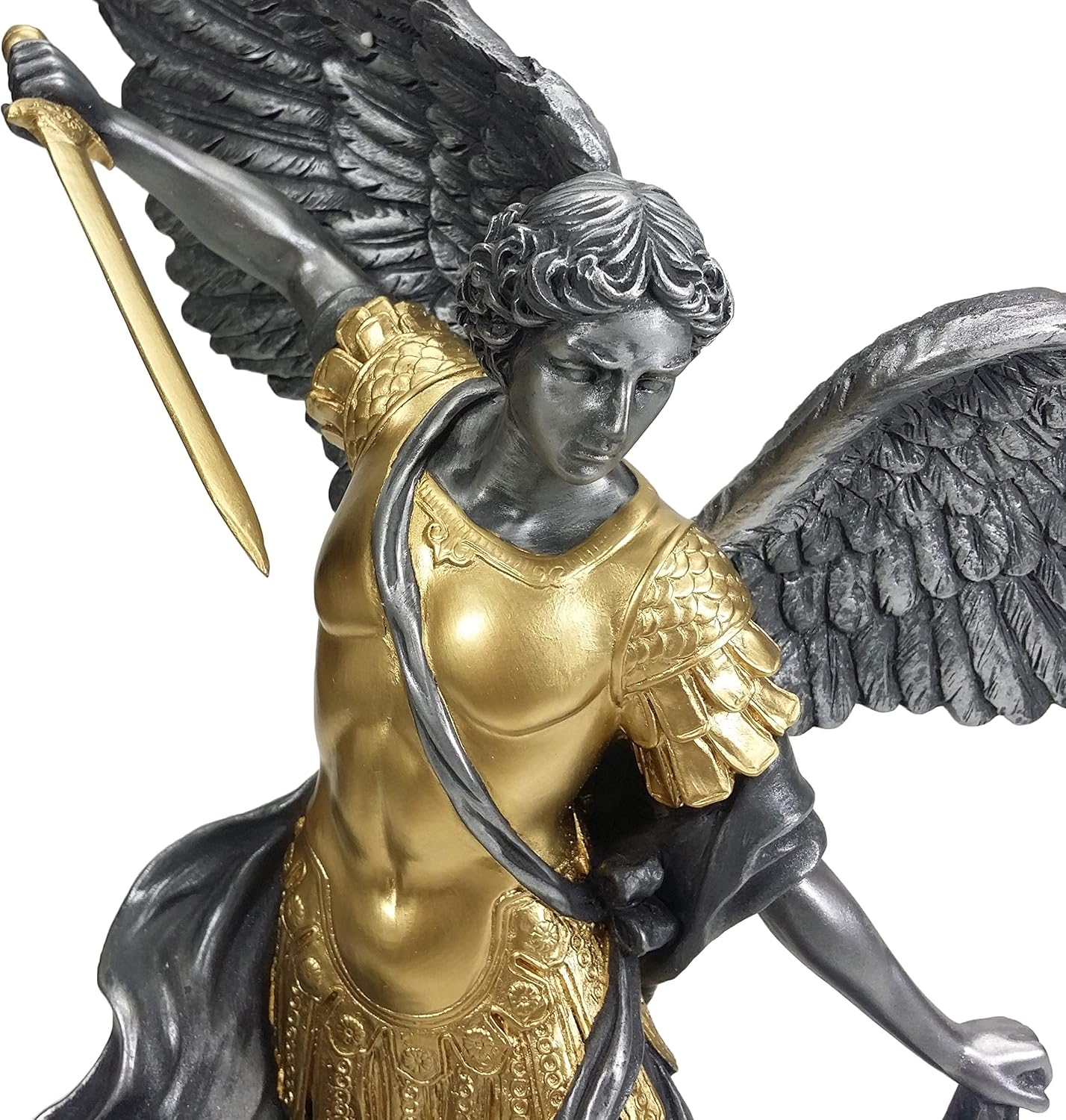
This 14½-inch UNICORN STUDIO statue depicts Michael standing over a demon in a pewter-and-gold-colored design. It offers a traditional artistic representation for a shelf or display cabinet; the sculpture does not establish Michael’s biblical appearance.
Saint Michael medal necklace
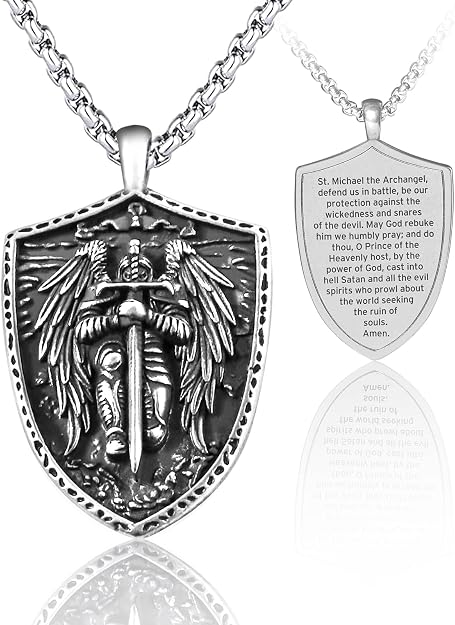
Malihome’s Shield-2 necklace features a shield-shaped Saint Michael medal. It is devotional jewelry for someone who values a wearable symbol of faith, or a gift chosen for that personal meaning.
For a broader starting point, explore what the Bible says about guardian angels and which angelic names Scripture supplies.
From biblical questions to an imagined guardian’s world
Gus is a fictional guardian whose family adventures explore faith, affection and the patience love requires. His story is separate from the biblical teaching above. If that blend of warmth and humor appeals to you, read the free opening of Gus the Guardian or explore the book.
Sources and translation note
Encounter summaries are paraphrases. Daniel and Jude were checked in the New American Bible, Revised Edition (NABRE); Revelation 12 in the World English Bible, Catholic edition; and 1 Thessalonians 4:16 in the New Revised Standard Version Updated Edition (NRSVUE). The linked church sources document particular interpretations and observances. Artwork is interpretive, and Gus is fictional.