Who Is Gabriel in the Bible, and Whom Does He Visit?
Gabriel is God’s messenger who explains visions to Daniel and announces important births to Zechariah and Mary. The Bible names him in Daniel 8 and 9 and Luke 1. Those passages call him an angel or describe his human appearance; they do not give him the title archangel.
Gabriel’s best-known visit is the announcement to Mary that she will bear Jesus. But his biblical story begins earlier, with a prophet trying to understand a troubling vision. Following the named encounters gives us a fuller picture of his service—and helps us avoid assigning his name to every unnamed messenger.
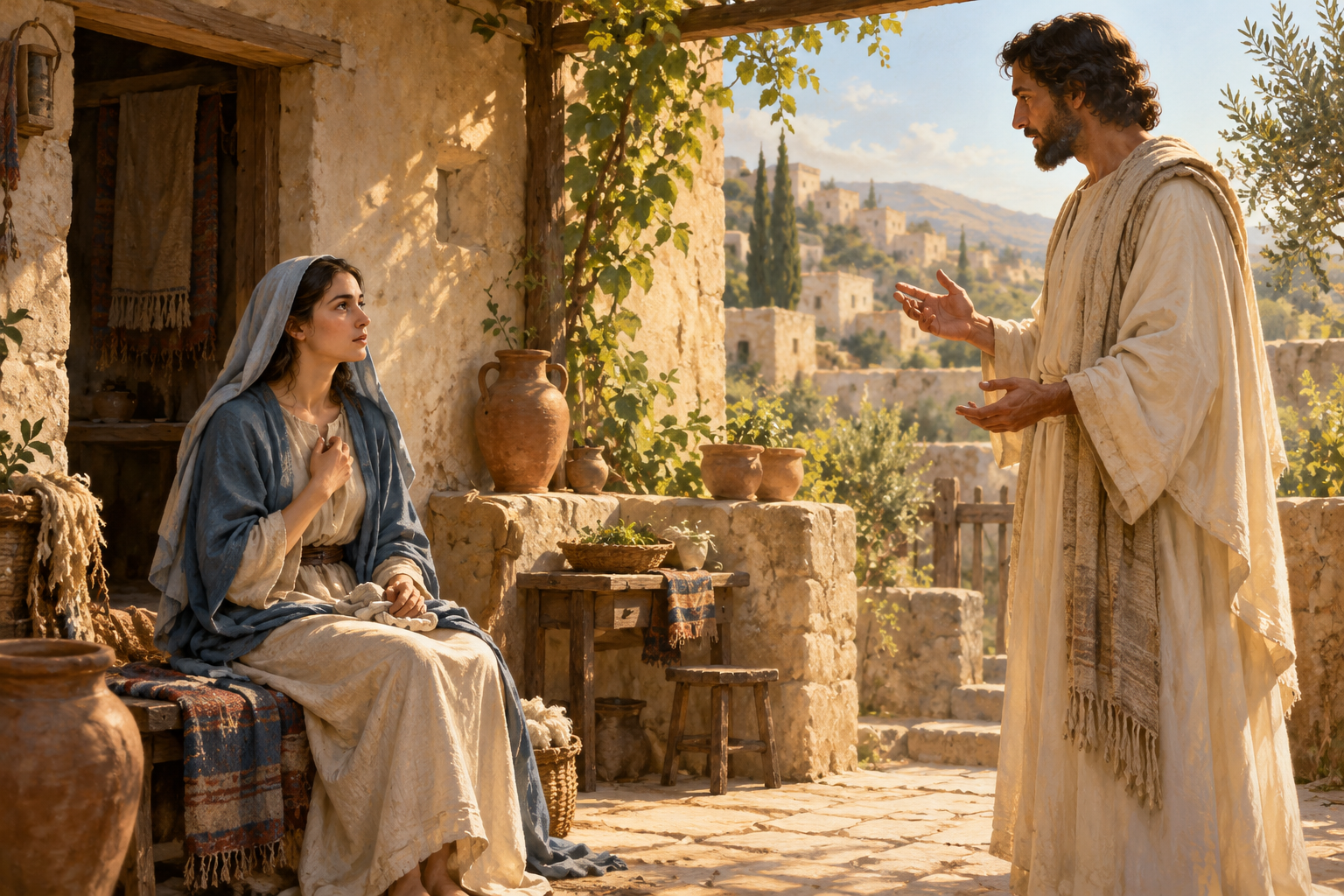
Original artistic interpretation of Gabriel’s announcement to Mary in Luke 1. The people’s appearances, clothing and courtyard are imagined; Luke does not describe the encounter in this visual detail.
Daniel: understanding a difficult vision
In Daniel 8, Daniel has seen a vision and is seeking its meaning. He sees someone with the appearance of a man, and a voice calls Gabriel by name and tells him to explain it. Daniel is frightened; Gabriel approaches, touches him and sets him upright. Daniel 8:15–19, NRSVUE.
The explanation concerns kingdoms and conflict, including the ram and the goat described in the vision. Gabriel’s task is interpretation. The passage does not present him as a friendly visitor dropping by with general advice, and Daniel is left shaken by the experience. Daniel 8:20–27.
This is worth remembering when angels are pictured as uniformly cozy or familiar. The biblical encounter can be overwhelming. Its importance lies in the message and Daniel’s response, not in a detailed description of Gabriel’s face or wings.
Daniel again: a message during prayer
Daniel 9 places Gabriel’s next named appearance in the setting of confession and prayer for Jerusalem. While Daniel is still praying, Gabriel arrives at the time of the evening offering and brings understanding. The text connects his arrival with Daniel’s petition. Daniel 9:20–23, NABRE.
Gabriel then delivers the difficult prophecy commonly described as the seventy weeks. Christians interpret its details differently. We do not need to settle every prophetic calculation to identify Gabriel’s role: he brings a message and helps Daniel understand what has been given. Daniel 9:24–27.
A useful reading habit is to distinguish the messenger’s task from our interpretation of the message. Gabriel’s presence is explicit; a particular modern timetable is not automatically established simply because it is attached to his name.
Zechariah: news at the altar of incense
Luke introduces the priest Zechariah and his wife Elizabeth as an older, childless couple. While Zechariah serves at the altar of incense, an angel appears and announces that Elizabeth will bear a son, John, who will prepare people for the Lord. Luke 1:5–17, NABRE.
When Zechariah questions how he can know this will happen, the messenger identifies himself as Gabriel and says that he stands before God. Zechariah is told he will be unable to speak until the promised events take place because he did not believe the message. Luke 1:18–23.
The scene joins an ordinary duty with extraordinary news. The priest has work to do, people are waiting outside, and an announcement interrupts expectations. Gabriel’s authority is tied to being sent by God; his identity is not a reason to detach the announcement from its purpose.
Mary: the announcement of Jesus’s birth
Luke next names Gabriel as the angel God sends to Mary in Nazareth. He tells her she will bear Jesus, whose kingship will have no end. When she asks how this can happen, Gabriel speaks of the Holy Spirit and God’s power, and points to Elizabeth’s pregnancy. Mary responds with willing acceptance. Luke 1:26–38, World English Bible.
Christians commonly call this encounter the Annunciation. It is central to Gabriel’s place in Christian remembrance, but the focus of the message is Jesus. Gabriel is the messenger; he is not the source of the promised child or the power that brings the promise about.
The account is moving without extra dialogue. We do not need to invent a long conversation, describe Mary’s room with certainty or give Gabriel a personality history to appreciate the courage involved in receiving unexpected news.
Whom does Gabriel visit?
| Person | Named passage | Purpose of the encounter |
|---|---|---|
| Daniel | Daniel 8:15–27 | Explains a vision involving kingdoms and conflict. |
| Daniel | Daniel 9:20–27 | Brings understanding during prayer. |
| Zechariah | Luke 1:11–20 | Announces John’s birth and mission. |
| Mary | Luke 1:26–38 | Announces Jesus’s birth. |
Was Gabriel also the angel who visited Joseph?
Matthew describes an angel of the Lord speaking to Joseph in dreams, but does not name that messenger Gabriel. The announcements in Luke and the dreams in Matthew belong together in the wider story of Jesus’s birth, yet their details should remain distinct. Matthew 1:18–25, NABRE; Matthew 2:13, 19–22.
The same care applies to Daniel 10. Gabriel has appeared in earlier chapters, so some readers identify the later messenger with him; the USCCB note on Daniel 10:5–6 proposes Gabriel. The chapter itself does not provide that name. A commentary’s identification is an interpretation, even when it is reasonable. Daniel 10 and note on 10:5–6.
Our article on angels appearing in dreams explores Joseph’s experiences more closely. Gabriel’s profile can stand alongside it because it answers a different question: which encounters actually name him?
Why do churches call Gabriel an archangel?
Gabriel is honored as an archangel in Catholic and Orthodox worship. The Catholic September 29 observance names Michael, Gabriel and Raphael, and the Orthodox Church in America’s account of the heavenly powers includes Gabriel among the archangels. That is established church usage. Vatican Directory on Popular Piety, 215; OCA Synaxis account.
It remains helpful to distinguish that usage from the wording of the named encounters. Luke calls Gabriel an angel; Daniel describes his appearance and mission. Jude 9 explicitly calls Michael the archangel. Saying exactly where a title comes from respects both Scripture and the traditions that receive it.
For more on that distinction, read our comparison of guardian angels and archangels.
What does Gabriel look like?
Daniel 8 describes a human-like appearance, and Daniel 9 refers back to the figure Daniel had seen. The named passages do not supply a wing count, a halo, a trumpet or a detailed portrait. Christian artwork interprets the encounters; it should not be confused with a description supplied by the text.
That is why the illustration here is labeled as an artistic interpretation. Its purpose is to help a reader pause over the encounter, while the passage remains the source for what we claim happened.
The thread connecting Gabriel’s encounters
Across these accounts, Gabriel serves as a messenger who helps people receive what God is making known. The settings differ: a bewildering vision, a prayer, a priest’s service and an unexpected announcement. The recurring emphasis is faithful communication.
One thoughtful way to read the passages is to notice both the message and the listener. What is being announced? How does the person respond? Those questions keep Gabriel’s service connected to the human story and to God’s purposes, rather than making the angel an object of speculation.
Optional Faith-Inspired Gifts
As an Amazon Associate I earn from qualifying purchases.
Gabriel statue with trumpet and staff
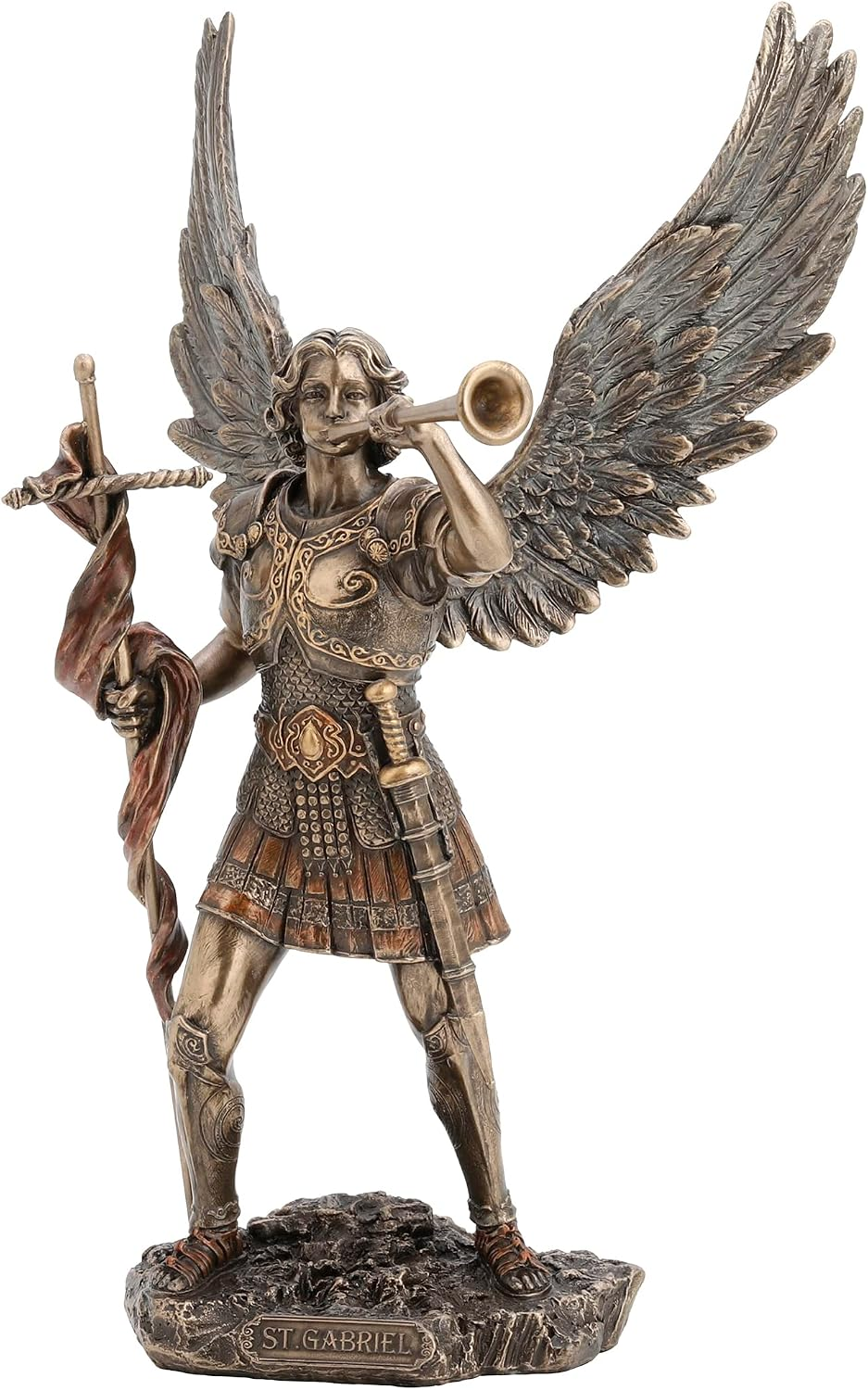
This Gabriel statue depicts the heavenly messenger with raised wings, a trumpet, and a staff. It offers a traditional artistic interpretation for a home display or faith-inspired gift; these visual details are not a portrait supplied by the biblical text.
Continue with Do Guardian Angels Have Names? or Can Guardian Angels Communicate With People? for related questions.
From biblical questions to an imagined guardian’s world
Gus is a fictional guardian whose family adventures explore faith, affection and the patience love requires. His story is separate from the biblical teaching above. If that blend of warmth and humor appeals to you, read the free opening of Gus the Guardian or explore the book.
Sources and translation note
This article paraphrases the biblical accounts rather than inventing speech. Daniel 8 was checked in NRSVUE; Daniel 9–10, Matthew 1–2 and Luke 1 in NABRE; Luke 1 was also checked in the World English Bible. The Catholic and Orthodox sources document traditional titles. No complete biography or exact visual likeness is supplied by these passages.